Tom Alter, well known actor, writer and sports journalist, is in NID for the next few days.He acts in 'Ocean of an Old Man',an extraordinary film, made in the aftermath of the 2004 Tsunami devastations that took and altered lives forever. Tom Alters will also perform a play+ give a Baatein session over the next few days.
Stills from the film:
Tom Alter is the son of American missionaries, and has lived in India all his life. He is best recalled for acting in the long running TV Serial 'Junoon', in Satyajit Ray's Shatranj Ke Khiladi, Sardar(1993),and the Hollywood film 'One night with the King'. Alters has also acted in a long list of Hindi films for the past two decades. In theatre, he has contributed to William Dalrymple's 'City of Djinns' (2007) with Zohra Sehgal, and 'Maulana', based on the life of Maulana Azad. He was recently awarded the Padmashree.
Ocean of an Old Man (2008) 100 Min Directed by Rajesh Shera Lead Actor: Tom Alters A schoolteachers' life consists of meeting his young, angel-like students who travel every day to school from neighbouring islands. His reality is wiped away, one day, when the Ocean takes away his loved ones. When the Government evacuates the islanders, he chooses to stay back in an old Japanese bunker on the devastated island. This is his story.
Tuesday 24th February 6 15 Audi
He's also going to enact a play in the Amphi, and give a Baatein session through the duration of his stay.Contact KHEL and Baatein for those details.
Screening of tuesdays film 'Good morning Babylon',has hence been cancelled in place of OCEAN.
Finally! A collection of posters from across the last 2 and a half semesters were finally collected,dusted,and put up for display in the foyer. Display ran Thursday and Friday,print posters were also up. Rather exciting prizes also due for the BEST POSTER and two runner-ups. Results are out very,very soon.
I decided to go about the screening of The Pianist,by Roman Polanski,in a big way.Filmclub actually got a lot of email requests(in one case,a PD chap one exchange voiced his enthusiasm over the selection.) and hence a lot of publicity biz was done. Anish Dasgupta(foundation) wanted to try making bookmarks rather than handouts,an installation was also set up outside the Audi. Glad it all worked out.:)
Dweepa(kannada),directed by Girish Kasaravalli and a National award winner,marked the start of the Pongal Film Festival in January. The much-appreciated(therefore flicked,repeatedly,hours before screening began)poster was worked on by Arunprakash, a PG 2nd semester Animation student.
What happens to most well-recieved innovations? They spread out, reinvent themselves, get 'branded',numbers increase...heck, CCD,RelianceFresh,even RK egg eatery bear testament to that.
Its about time G-NID(Gandhinagar NID,to you) got kick-started. And thanks to intervention from Sekhar Mukherjee and Kanika( TAD,1st yr) Their Audi will soon be graced with regular film screenings and audience of the like; making this a landmark for Film Club.Both of them.:) Personally, I'm glad Gandhinagar and Paldi have this common link, and lets hope for many more in the future.
Next Update. Film CluB Poster Exhibition scheduled this month. Posters being uprooted from across the last two semesters, and the best one of course will receive a substantial goody-bag type prize from Crosswords. Similar plans for FIN Promos;regarding which many enthusiasts have promised new promos this semester.
To those who take a peek at this lonely blogspot- it aint resting in peace yet.
First things first:Current SCREENINGS. 'December Classics' was the theme,continueing into Jan.We're moving across the continent,starting with the epic 'Gone with the Wind' and entering UK,Europe,India(local classics),the Orient, and so on.
Dec 23 8 1/2 (Fredrico Felinni,Italy) 27 Blow up (Antonioni,Italy)
30 Metropolis( Fritz Lang,Germany) 31 New Years Eve Special: Oliver Twist (David Lean,Great Britain)
Jan 1 New Years Day: Triplets of Belleville(animation,France) 6 Rules of the game( Renoir,France) 8 Macbeth (Orson Welles)
Will wonders never cease?An overseas poster flew into our inbox,in an unusual format a day before Million Dollar Hotel was screened during the last week of the semester.And its never to late to archive. And from an Ex-FIn member too.Much obliged to (and inspired/impressed by!) Shreyas Krishnan 7th Sem Graphic Design for this one. :)
(Handout by Pragya Mishra,7th semester Graphic Design) Tuesdays screening was 'Notebook on cities and clothes'. Wim Wenders and Yohji Yamamoto chat about cities and clothes,with Yamamotos unimitatable,refreshingly blasphemous takes on his city(Tokyo),the conflict of identity and affirmations that 'Im a dressmaker,not a fashion designer'.
A documentary,or perhaps going beyond the definition of one?
True this may be,despite that thou might disagree!
Once in a while,people take the initiative to holler back a response after yet another cycle of screenings.As the semester comes to a close,Manish Desai from TAD,3rd semester PG sent in an email on tuesdays' film: " A designer could connect very well to it. It also examined the nature of documentary and somehow it was about inner conversations between two people brought out in movie."
Take a peek at his blog http://ekantik.wordpress.com/2008/10/21/in-my-mirror/ and see for yourself. More words like this,if not a review or 'critical cinematographic analysis' will cause the FIN blog to do a hearty (yet dignified,mind) jig on the NID server.
The Buena Vista Social club was born in 1949 in a neighbourhood in Havana,capital of Cuba.The members only club was a place for musicians to meet,play their music together and smoke a cigar or two. They sang of the ancient deities of fire and water, gave birth to the New World Afro Caribbean religion of Santería, the spiritual heart of Cuban music. A smooth blend of African percussion,European bass and loose American influences was played.
Pianist Rubén González, who played piano on the 1990s recordings, described the 1940s as "an era of real musical life in Cuba, where there was very little money toearn, but everyone played because they really wanted to". The era saw the birth of the jazz influenced mambo, the charanga, and dance forms such as the pachanga and the cha-cha-cha, as well as the continued development of traditional Afro-Cuban musical styles such as rumba and son.
From the 1960s,the cuban governement began a program of shutting down all nighttime entertainment centers-namely gambling outlets,nightclubs and other places associated with Havana's hedonistic,or pleasure-pursueing reputation. A rapid shift to Communism to build a 'classless and colourless society' meant a redefining of forms of expression in the black community. social and cultural centers were abolished and funds stopped,and with that, a whole generation of music and musicans burnt out.
Cold war politics,namely America's suspicious attitude toward Castro's regime,further discouraged revolutionary ideals and the passage of cuban music into america,such as the beginnings of the latino craze in the early 20th century in Europe and America. By the late 60s, the distinctness of the myriad sub-genres of Cuban tropical music began to blur, diluting into the generic "salsa" that we have today.
The closure of the buena vista social club was inevitable.
In 1996, American guitarist Ry Cooder was invited to Havana by British world music producer Nick Gold of World Circuit Records to record a session where two African High-life musicians from Mali were to collaborate with Cuban musicians.On Cooder's arrival (via Mexico to avoid the ongoing U.S. trade and travel embargo against Cuba).Plans changed and Cooder and Gold decided to record an album of Cuban son music with local musicians.A total of 20 musicans contributed,finally. Communication between the Spanish and English speakers at the studio was conducted via an interpreter, although Cooder reflected that "musicians understand each other through means other than speaking" Upon release on 17 September 1997, the CD became a huge "word of mouth hit".It sold more than 5 million copies and won a Grammy award in 1998.In 2003 it was listed by the New York based Rolling Stone magazine as #260 in The 500 Greatest Albums of All Time. Ry Cooder inspired New German Cinema director wim wenders to film the new beginnings of the buena vista social club album.The performers had concerts in New York and Amsterdam.Footage of the recording sessions,interviews with the musical veterans and final shots of the rural islanders in the Big Apple(some had never stepped beyond their island) were what make some of the most moving scenes in the documentary.No wonder Wenders quoted "..didnt feel like a documentary anymore,feels like a character piece." The international success of the Buena Vista Social Club generated a revival of interest in traditional Cuban music and Latin American music as a whole,and they continued to tour the world,remarkably...something of a music anamoly!
refer to http://wim-wenders.com http://pbs.org/buena vista for more information and extraordinary photography taken by Wenders and his wife.
"Sex and violence was never really my cup of tea; I was always more into sax and violins."
Who is Wim Wenders?
Ernst Wilhelm ("Wim") Wenders (born August 14, 1945) is a German film director, playwright, author, photographer and producer.
After dabbling in medicine,philosophy,painting and finally as an engraver,Wenders decided to follow his obsession after watching upto 5 movies every day at the local theatre.He joined the University of Film & Television Munich in 1967 that fall,subsequently as a film critic.
He debuted in the 1960s as part of the New German Cinema with 'Summer in the City' and earned further honours between 1982-87 at the Venice Film Festival,Cannes Film Festival,Bavarian Film Awards and Locarno International Film Festival.
AND this fortnight is the Wim Wenders Film Festival- 6 films across 2 weeks; every tuesday to thursday.
14th- The American Friend(1977) 15th- Tokyoga(1985) 16th- Wings of Desire(1987)
21st- Notebook on Cities and Clothes(1989) 22nd- Buena Vista Social Club(1999) 23rd- Million Dollar Hotel(2000)
Do contact one of us if you'd like to do an introduction or make a poster!
Today we have a special screening to go with the election for the new Filmclub managing committe (2008-2009). (Results to be posted soon).
From the Animation studio that brought you Animatrix comes this visually stunnig new anime film based on the popular Japanese manga written by Taiyo Matsumoto. In Treasure Town, life can be both gentle and brutal. This is never truer than for our heroes, Black and White, two street urchins who watch over the city, doing battle with an array of old-world Yakuza and alien assassins vying to rule the decaying metropolis.
Sholay can be said to have inaugurated the modern period of commercial Hindi cinema. Often described as India's best-known "curry" western, Sholay was 'patterned' on American spaghetti westerns, though as with any other good Hindi film, the presumed 'copy' is at least as interesting as the 'original'. The addition of romance, comedy, and songs gave it the ambiance that one expects of a Hindi film. The film narrates the story of an ex-cop Thakur Baldev Singh (Sanjeev Kumar) who hires two jail birds (Amitabh Bachchan and Dharmendra) to eradicate a town and neighbouring villages of the menace of Gabbar Singh (Amjad Khan) and his band of dreaded dacoits.
The film made use of several interesting innovations. This included its spectacular cinematography, with shots panning over rocky heights and barren canyons, often under menacing clouds. This lends the movie much of its eerie tension. One of the long opening scenes, which shows a train being defended by Baldev Singh against an attack by bandits, is quite spectacular in its effects, and is reminiscent of similar scenes in westerns, most notably John Ford's "Stagecoach" (1939). Sholay, likewise, plays upon themes of nature versus culture, the encroachment of nature upon culture, and the meaning of civilization in wilderness.
“Kitne aadmi the?”
But Sholay will also be remembered for the heights it took villainy to in Indian films. Unlike earlier villains who were content to bring about a misunderstanding between the lovers' families, Amjad Khan's Gabbar seems to pursue evil as an end in itself.
Sholay presents interesting parallels with its predecessor by nearly two decades, Mehboob Khan's Mother India, notably in the enduring trope of the daku (Indian English "dacoit") or highwayman—an outlaw whose popular representations span the gamut from freedom-loving Robin Hood to rapacious sociopath. Unlike in the former, the dakus of Sholay—from their first appearance in the flashback of the train-shootout—are unambiguously evil and bent on carnage, yet they are apparently ensconced in the very heart of the nation (the film's visual setting is the plateau country of the northern Deccan, India's midsection), and the forces of social order (here focused in the brooding patriarch, Thakur Baldev Singh) are powerless to defeat them. Indeed, the sadistic Gabbar Singh has brutally murdered this "Father India's" two sons and has literally cut off his law-administering arms (cf. the comparable though "accidental" mutilation of the father in Mother India). To strike back, Singh must (as he puts it) "use iron to cut iron," replacing his slain offspring and severed arms with two "adopted" criminal “hands,” who alone possess the requisite bravery (and moral ambivalence) to track down the monster in his lair.
Significantly, a mere six weeks before the premiere of Sholay, on June 26 1975, another self-styled "Mother India," Prime Minister Indira Gandhi, claiming that anti-social forces imperiled the nation and that draconian measures were required to prevent chaos, imposed a "State of Emergency," suspending constitutional rights and jailing thousands of political opponents. In retrospect, Sippy’s cinematic epic appears as a surprisingly dark and prescient parable of the erosion of traditional order and the brutalization of politics in the once-happy village of Ramgarh—the Nation writ cinemascope.
One of the biggest hits in history of Bollywood, Sholay (in English as Embers, Flames, Flames of the Sun), was recognized as the Best Film of 50 years at the 50th Filmfare awards. It was India's first 70 mm, stereophonic sound film and was released on Friday, August 15, 1975, with as many as 250 prints, including at the Minerva Theatre in Bombay (now Mumbai). This was the first film in the history of Indian cinema to celebrate silver jubilee (25 weeks) at over a hundred theatres across India. To date, more than 1,100 prints of Sholay are in circulation-the highest number for any Hindi film.
Although initially declared a commercial disaster, Sholay went on to become the most successful film in Indian film history. It is the highest grossing movie of all time in India with collections of Rs. 2,134,500,000/- or US $ 50 million. Even today, it remains the box office gold, a reference point for both the Indian film-going audience & the film industry.
The large cast of super-stars contributed to that, as did the memorable dialogues between Gabbar and Baldev Singh, and between Gabbar and his henchmen. Amjad Khan played the role with perfection, and not without sardonic humor. His lines became so popular that cassettes of Gabbar's dialogues were being sold separately, to be learnt by rote by millions of movie goers.
It is widely acknowledged by movie critics to be one of the best movies ever created by Bollywood and to be the most watched and popular. It was declared "Film of the Millenium" by BBC India and internet polls in 1999.
This week we return to Westerns, not Spaghetti Westerns though. We start with
STAGECOACH John Ford
Although there were Westerns before it, Stagecoach quickly became a template for all movie Westerns to come. Director John Ford combined action, drama, humor, and a set of well-drawn characters in the story of a stagecoach set to leave Tonto, New Mexico for a distant settlement in Lordsburg, with a diverse set of passengers on board.
Dallas a woman with a scandalous past who has been driven out of town by the high-minded ladies of the community. Lucy Mallory is the wife of a cavalry officer stationed in Lordsburg, and she's determined to be with him. Hatfield is a smooth-talking cardsharp who claims to be along to "protect" Lucy, although he seems to have romantic intentions. Dr. Boone is a self-styled philosopher, a drunkard, and a physician who's been stripped of his license. Mr. Peacock is a slightly nervous whiskey salesman (and, not surprisingly, Dr. Boone's new best friend). Gatewood a crooked banker who needs to get out of town. Buck is the hayseed stage driver, and Sheriff Wilcox is along to offer protection and keep an eye peeled for the Ringo Kid (John Wayne), a well-known outlaw who has just broken out of jail.
While Wilcox does find Ringo, a principled man who gives himself up without a fight, the real danger lies farther down the trail, where a band of Apaches, led by Geronimo, could attack at any time.
Stagecoach offers plenty of cowboys, Indians, shootouts, and chases, aided by Yakima Canutt's remarkable stunt work and Bert Glennon's majestic photography of Ford's beloved Monument Valley. It also offers a strong screenplay by Dudley Nichols with plenty of room for the cast to show its stuff. John Wayne's performance made him a star after years as a B-Western leading man, and Thomas Mitchell won an Oscar for what could have been just another comic relief role. Thousands of films have followed Stagecoach's path, but no has ever improved on its formula.
RGV’s most notable film to date and one that has set standards in its genre is Satya. Satya is the story of an impoverished man who is so dehumanized by society that the only way he can regain some of his humanity is by becoming a cold-blooded killer. It is said that the first thirty minutes of Satya are one of the best thirty minutes of Hindi cinema. It is an entirely different type of gangster film, in that there is no stylish portrayal of gangster life, nor is it a typical cat and mouse game between the police and thugs or between rival gangsters.
Film noir is a cinematic term used primarily to describe stylish Hollywoodcrime dramas, particularly those that emphasize moral ambiguity and sexual motivation. Hollywood's classic film noir period is generally regarded as stretching from the early 1940s to the late 1950s. Film noir of this era is associated with a low-keyblack-and-white visual style that has roots in German Expressionistcinematography, while many of the prototypical stories and much of the attitude of classic noir derive from the hardboiled school of crime fiction that emerged in the United States during the Depression.
The term film noir (French for "black film"), first applied to Hollywood movies by French critic Nino Frank in 1946, was unknown to most American film industry professionals of the era. Cinema historians and critics defined the canon of film noir in retrospect; many of those involved in the making of the classic noirs later professed to be unaware of having created a distinctive type of film.
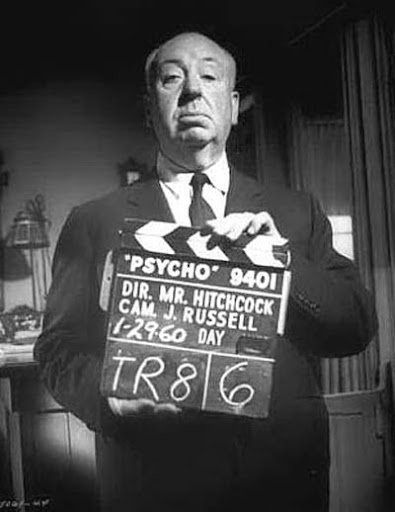
What better way to start off a week of Noir films, than with the Master of Suspense himself. Alfred Hitchcock.
"There is no terror in a bang, only in the anticipation of it."
One of the most famous-- and possibly apocryphal-- Hitchcock anecdotes concerns a five-year-old Alfred Hitchcock, sent to the local police station with a note from his father after some mischief-making.After reading the note, a sergeant put young Alfred in a cell, and left him there for a few agonizing moments.The policeman returned and let Alfred go, only to tell him, "This is what we do to naughty boys." True or not, this story and Hitchcock's Roman Catholic background encompass all the themes Hitchcock would later put in his work-- terror inflicted upon the unknowing, and sometimes innocent victim; guilt (both real guilt and the appearance of it); fear, and redemption.
PSYCHO 1960
This is the film that best epitomises how Hitchcock could mis-direct audiences and play games with them.Psycho (1960) is the "mother" of all modern horror suspense films - it single-handedly ushered in an era of inferior screen 'slashers' with blood-letting and graphic, shocking killings (e.g., Homicidal (1961), The Texas Chainsaw Massacre (1974), Halloween (1978), Motel Hell (1980), and DePalma's Dressed to Kill (1980) - with another transvestite killer and shower scene).
SAUL BASS (1920-1996) was not only one of the great graphic designers of the mid-20th century but the undisputed master of film title design thanks to his collaborations with Alfred Hitchcock, Otto Preminger and Martin Scorsese. He is known for reinventing the movie title as an art form.
Haunting is the word to describe the vertical bars sweeping across the screen in a manic, mirrored helter-skelter motif at the beginning of Hitchcock’s 1960 Psycho. This staccato sequence is an inspired symbol of Norman Bates’ fractured psyche. Hitchcock also allowed Bass to work on the film itself, notably on its dramatic highpoint, the famous shower –murder scene with Janet Leigh.
TRIVIA
The film only cost $800,000 to make yet has earned more than $40,000,000. Hitchcock used the crew from his TV series to save time and money. In 1962 exchanged the rights to the film and his TV-series for a huge block of MCA's stock (he became their third largest stockholder).
Robert Bloch's original novel was inspired by the notorious serial killer Ed Gein who was also one of the inspirations for the character of Hannibal Lector (The Silence of the Lambs/Manhunter).
Hitchcock bought the rights to the novel anonymously from Robert Bloch for just $9,000. He then bought up as many copies of the novel as he could to keep the ending a secret.
The blood in the shower scene is actually chocolate sauce.
The shot of Janet Leigh flushing the toilet is believed to be the first such shot in American cinema history.
The MPAA refused to pass this film because they claimed to be able to see Janet Leigh's nipple during the shower scene. Hitchcock didn't edit it out, but merely sent it back, (correctly, it seems) assuming that they either wouldn't bother to watch it, or miss it the second time.
Hitchcock insisted that audiences should only be allowed to see the film from the start so as not to ruin the surprise. This was unheard of back then as people were used to just coming in at any point during a movie.
After the film's release Hitchcock received an angry letter from the father of a girl who refused to have a bath after seeing Diabolique and now refused to shower after seeing Psycho. Hitch sent a note back simply saying "Send her to the dry cleaners".
This week, Filmclub brings to you student films from the following schools. These were received as entries for the Chitrakatha film festival held at NID
CONSPIRATORS OF PLEASURE {SPIKLENCI SLASTI} Jan Svankmajer 1996 Revered Czech animator Svankmajer's 1993 film is a virtually dialogue-free exploration of the strange intimate workings of the lives of six common people. Through a disturbing mix of live action and the wondrous stop-motion animation...Revered Czech animator Svankmajer's 1993 film is a virtually dialogue-free exploration of the strange intimate workings of the lives of six common people. Through a disturbing mix of live action and the wondrous stop-motion animation that the director is famous for, the humdrum lives of a postwoman, shopkeeper, television presenter, detective, and two apartment dwellers are examined and intertwined while we see the elaborate processes these people go through to satisfy strange fetishes which involve food, animals, and everything in between in a way which is not all sexual to the observer.
About the director: After studying at the Institute of Industrial Arts and the Marionette Faculty of the Prague Academy of Fine Arts in the 1950s, Jan Svankmajer started working as a theatre director, chiefly in association with the Theatre of Masks and the Black Theatre. He first experimented with film-making after becoming involved with the mixed-media productions of Prague's Lanterna Magika Theatre. He began making short films in 1964, and continued working in the same medium for over twenty years, when he finally achieved his long-held ambition to make a feature film based on Lewis Carroll's Alice in Wonderland (Neco z Alenky (1988)). He has also exhibited his drawings, collages and 'tactile sculptures', many of which were produced in the mid-1970s, when he was temporarily banned from film-making by the Czech authorities. He has been a card-carrying member of the Prague Surrealist Group since 1969.