(Handout by Pragya Mishra,7th semester Graphic Design) Tuesdays screening was 'Notebook on cities and clothes'. Wim Wenders and Yohji Yamamoto chat about cities and clothes,with Yamamotos unimitatable,refreshingly blasphemous takes on his city(Tokyo),the conflict of identity and affirmations that 'Im a dressmaker,not a fashion designer'.
A documentary,or perhaps going beyond the definition of one?
True this may be,despite that thou might disagree!
Once in a while,people take the initiative to holler back a response after yet another cycle of screenings.As the semester comes to a close,Manish Desai from TAD,3rd semester PG sent in an email on tuesdays' film: " A designer could connect very well to it. It also examined the nature of documentary and somehow it was about inner conversations between two people brought out in movie."
Take a peek at his blog http://ekantik.wordpress.com/2008/10/21/in-my-mirror/ and see for yourself. More words like this,if not a review or 'critical cinematographic analysis' will cause the FIN blog to do a hearty (yet dignified,mind) jig on the NID server.
The Buena Vista Social club was born in 1949 in a neighbourhood in Havana,capital of Cuba.The members only club was a place for musicians to meet,play their music together and smoke a cigar or two. They sang of the ancient deities of fire and water, gave birth to the New World Afro Caribbean religion of Santería, the spiritual heart of Cuban music. A smooth blend of African percussion,European bass and loose American influences was played.
Pianist Rubén González, who played piano on the 1990s recordings, described the 1940s as "an era of real musical life in Cuba, where there was very little money toearn, but everyone played because they really wanted to". The era saw the birth of the jazz influenced mambo, the charanga, and dance forms such as the pachanga and the cha-cha-cha, as well as the continued development of traditional Afro-Cuban musical styles such as rumba and son.
From the 1960s,the cuban governement began a program of shutting down all nighttime entertainment centers-namely gambling outlets,nightclubs and other places associated with Havana's hedonistic,or pleasure-pursueing reputation. A rapid shift to Communism to build a 'classless and colourless society' meant a redefining of forms of expression in the black community. social and cultural centers were abolished and funds stopped,and with that, a whole generation of music and musicans burnt out.
Cold war politics,namely America's suspicious attitude toward Castro's regime,further discouraged revolutionary ideals and the passage of cuban music into america,such as the beginnings of the latino craze in the early 20th century in Europe and America. By the late 60s, the distinctness of the myriad sub-genres of Cuban tropical music began to blur, diluting into the generic "salsa" that we have today.
The closure of the buena vista social club was inevitable.
In 1996, American guitarist Ry Cooder was invited to Havana by British world music producer Nick Gold of World Circuit Records to record a session where two African High-life musicians from Mali were to collaborate with Cuban musicians.On Cooder's arrival (via Mexico to avoid the ongoing U.S. trade and travel embargo against Cuba).Plans changed and Cooder and Gold decided to record an album of Cuban son music with local musicians.A total of 20 musicans contributed,finally. Communication between the Spanish and English speakers at the studio was conducted via an interpreter, although Cooder reflected that "musicians understand each other through means other than speaking" Upon release on 17 September 1997, the CD became a huge "word of mouth hit".It sold more than 5 million copies and won a Grammy award in 1998.In 2003 it was listed by the New York based Rolling Stone magazine as #260 in The 500 Greatest Albums of All Time. Ry Cooder inspired New German Cinema director wim wenders to film the new beginnings of the buena vista social club album.The performers had concerts in New York and Amsterdam.Footage of the recording sessions,interviews with the musical veterans and final shots of the rural islanders in the Big Apple(some had never stepped beyond their island) were what make some of the most moving scenes in the documentary.No wonder Wenders quoted "..didnt feel like a documentary anymore,feels like a character piece." The international success of the Buena Vista Social Club generated a revival of interest in traditional Cuban music and Latin American music as a whole,and they continued to tour the world,remarkably...something of a music anamoly!
refer to http://wim-wenders.com http://pbs.org/buena vista for more information and extraordinary photography taken by Wenders and his wife.
"Sex and violence was never really my cup of tea; I was always more into sax and violins."
Who is Wim Wenders?
Ernst Wilhelm ("Wim") Wenders (born August 14, 1945) is a German film director, playwright, author, photographer and producer.
After dabbling in medicine,philosophy,painting and finally as an engraver,Wenders decided to follow his obsession after watching upto 5 movies every day at the local theatre.He joined the University of Film & Television Munich in 1967 that fall,subsequently as a film critic.
He debuted in the 1960s as part of the New German Cinema with 'Summer in the City' and earned further honours between 1982-87 at the Venice Film Festival,Cannes Film Festival,Bavarian Film Awards and Locarno International Film Festival.
AND this fortnight is the Wim Wenders Film Festival- 6 films across 2 weeks; every tuesday to thursday.
14th- The American Friend(1977) 15th- Tokyoga(1985) 16th- Wings of Desire(1987)
21st- Notebook on Cities and Clothes(1989) 22nd- Buena Vista Social Club(1999) 23rd- Million Dollar Hotel(2000)
Do contact one of us if you'd like to do an introduction or make a poster!
Today we have a special screening to go with the election for the new Filmclub managing committe (2008-2009). (Results to be posted soon).
From the Animation studio that brought you Animatrix comes this visually stunnig new anime film based on the popular Japanese manga written by Taiyo Matsumoto. In Treasure Town, life can be both gentle and brutal. This is never truer than for our heroes, Black and White, two street urchins who watch over the city, doing battle with an array of old-world Yakuza and alien assassins vying to rule the decaying metropolis.
Sholay can be said to have inaugurated the modern period of commercial Hindi cinema. Often described as India's best-known "curry" western, Sholay was 'patterned' on American spaghetti westerns, though as with any other good Hindi film, the presumed 'copy' is at least as interesting as the 'original'. The addition of romance, comedy, and songs gave it the ambiance that one expects of a Hindi film. The film narrates the story of an ex-cop Thakur Baldev Singh (Sanjeev Kumar) who hires two jail birds (Amitabh Bachchan and Dharmendra) to eradicate a town and neighbouring villages of the menace of Gabbar Singh (Amjad Khan) and his band of dreaded dacoits.
The film made use of several interesting innovations. This included its spectacular cinematography, with shots panning over rocky heights and barren canyons, often under menacing clouds. This lends the movie much of its eerie tension. One of the long opening scenes, which shows a train being defended by Baldev Singh against an attack by bandits, is quite spectacular in its effects, and is reminiscent of similar scenes in westerns, most notably John Ford's "Stagecoach" (1939). Sholay, likewise, plays upon themes of nature versus culture, the encroachment of nature upon culture, and the meaning of civilization in wilderness.
“Kitne aadmi the?”
But Sholay will also be remembered for the heights it took villainy to in Indian films. Unlike earlier villains who were content to bring about a misunderstanding between the lovers' families, Amjad Khan's Gabbar seems to pursue evil as an end in itself.
Sholay presents interesting parallels with its predecessor by nearly two decades, Mehboob Khan's Mother India, notably in the enduring trope of the daku (Indian English "dacoit") or highwayman—an outlaw whose popular representations span the gamut from freedom-loving Robin Hood to rapacious sociopath. Unlike in the former, the dakus of Sholay—from their first appearance in the flashback of the train-shootout—are unambiguously evil and bent on carnage, yet they are apparently ensconced in the very heart of the nation (the film's visual setting is the plateau country of the northern Deccan, India's midsection), and the forces of social order (here focused in the brooding patriarch, Thakur Baldev Singh) are powerless to defeat them. Indeed, the sadistic Gabbar Singh has brutally murdered this "Father India's" two sons and has literally cut off his law-administering arms (cf. the comparable though "accidental" mutilation of the father in Mother India). To strike back, Singh must (as he puts it) "use iron to cut iron," replacing his slain offspring and severed arms with two "adopted" criminal “hands,” who alone possess the requisite bravery (and moral ambivalence) to track down the monster in his lair.
Significantly, a mere six weeks before the premiere of Sholay, on June 26 1975, another self-styled "Mother India," Prime Minister Indira Gandhi, claiming that anti-social forces imperiled the nation and that draconian measures were required to prevent chaos, imposed a "State of Emergency," suspending constitutional rights and jailing thousands of political opponents. In retrospect, Sippy’s cinematic epic appears as a surprisingly dark and prescient parable of the erosion of traditional order and the brutalization of politics in the once-happy village of Ramgarh—the Nation writ cinemascope.
One of the biggest hits in history of Bollywood, Sholay (in English as Embers, Flames, Flames of the Sun), was recognized as the Best Film of 50 years at the 50th Filmfare awards. It was India's first 70 mm, stereophonic sound film and was released on Friday, August 15, 1975, with as many as 250 prints, including at the Minerva Theatre in Bombay (now Mumbai). This was the first film in the history of Indian cinema to celebrate silver jubilee (25 weeks) at over a hundred theatres across India. To date, more than 1,100 prints of Sholay are in circulation-the highest number for any Hindi film.
Although initially declared a commercial disaster, Sholay went on to become the most successful film in Indian film history. It is the highest grossing movie of all time in India with collections of Rs. 2,134,500,000/- or US $ 50 million. Even today, it remains the box office gold, a reference point for both the Indian film-going audience & the film industry.
The large cast of super-stars contributed to that, as did the memorable dialogues between Gabbar and Baldev Singh, and between Gabbar and his henchmen. Amjad Khan played the role with perfection, and not without sardonic humor. His lines became so popular that cassettes of Gabbar's dialogues were being sold separately, to be learnt by rote by millions of movie goers.
It is widely acknowledged by movie critics to be one of the best movies ever created by Bollywood and to be the most watched and popular. It was declared "Film of the Millenium" by BBC India and internet polls in 1999.
This week we return to Westerns, not Spaghetti Westerns though. We start with
STAGECOACH John Ford
Although there were Westerns before it, Stagecoach quickly became a template for all movie Westerns to come. Director John Ford combined action, drama, humor, and a set of well-drawn characters in the story of a stagecoach set to leave Tonto, New Mexico for a distant settlement in Lordsburg, with a diverse set of passengers on board.
Dallas a woman with a scandalous past who has been driven out of town by the high-minded ladies of the community. Lucy Mallory is the wife of a cavalry officer stationed in Lordsburg, and she's determined to be with him. Hatfield is a smooth-talking cardsharp who claims to be along to "protect" Lucy, although he seems to have romantic intentions. Dr. Boone is a self-styled philosopher, a drunkard, and a physician who's been stripped of his license. Mr. Peacock is a slightly nervous whiskey salesman (and, not surprisingly, Dr. Boone's new best friend). Gatewood a crooked banker who needs to get out of town. Buck is the hayseed stage driver, and Sheriff Wilcox is along to offer protection and keep an eye peeled for the Ringo Kid (John Wayne), a well-known outlaw who has just broken out of jail.
While Wilcox does find Ringo, a principled man who gives himself up without a fight, the real danger lies farther down the trail, where a band of Apaches, led by Geronimo, could attack at any time.
Stagecoach offers plenty of cowboys, Indians, shootouts, and chases, aided by Yakima Canutt's remarkable stunt work and Bert Glennon's majestic photography of Ford's beloved Monument Valley. It also offers a strong screenplay by Dudley Nichols with plenty of room for the cast to show its stuff. John Wayne's performance made him a star after years as a B-Western leading man, and Thomas Mitchell won an Oscar for what could have been just another comic relief role. Thousands of films have followed Stagecoach's path, but no has ever improved on its formula.
RGV’s most notable film to date and one that has set standards in its genre is Satya. Satya is the story of an impoverished man who is so dehumanized by society that the only way he can regain some of his humanity is by becoming a cold-blooded killer. It is said that the first thirty minutes of Satya are one of the best thirty minutes of Hindi cinema. It is an entirely different type of gangster film, in that there is no stylish portrayal of gangster life, nor is it a typical cat and mouse game between the police and thugs or between rival gangsters.
Film noir is a cinematic term used primarily to describe stylish Hollywoodcrime dramas, particularly those that emphasize moral ambiguity and sexual motivation. Hollywood's classic film noir period is generally regarded as stretching from the early 1940s to the late 1950s. Film noir of this era is associated with a low-keyblack-and-white visual style that has roots in German Expressionistcinematography, while many of the prototypical stories and much of the attitude of classic noir derive from the hardboiled school of crime fiction that emerged in the United States during the Depression.
The term film noir (French for "black film"), first applied to Hollywood movies by French critic Nino Frank in 1946, was unknown to most American film industry professionals of the era. Cinema historians and critics defined the canon of film noir in retrospect; many of those involved in the making of the classic noirs later professed to be unaware of having created a distinctive type of film.
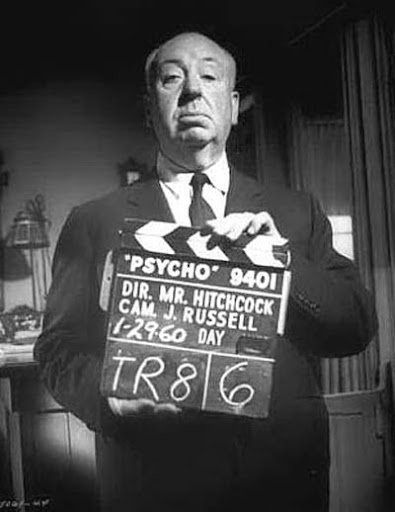
What better way to start off a week of Noir films, than with the Master of Suspense himself. Alfred Hitchcock.
"There is no terror in a bang, only in the anticipation of it."
One of the most famous-- and possibly apocryphal-- Hitchcock anecdotes concerns a five-year-old Alfred Hitchcock, sent to the local police station with a note from his father after some mischief-making.After reading the note, a sergeant put young Alfred in a cell, and left him there for a few agonizing moments.The policeman returned and let Alfred go, only to tell him, "This is what we do to naughty boys." True or not, this story and Hitchcock's Roman Catholic background encompass all the themes Hitchcock would later put in his work-- terror inflicted upon the unknowing, and sometimes innocent victim; guilt (both real guilt and the appearance of it); fear, and redemption.
PSYCHO 1960
This is the film that best epitomises how Hitchcock could mis-direct audiences and play games with them.Psycho (1960) is the "mother" of all modern horror suspense films - it single-handedly ushered in an era of inferior screen 'slashers' with blood-letting and graphic, shocking killings (e.g., Homicidal (1961), The Texas Chainsaw Massacre (1974), Halloween (1978), Motel Hell (1980), and DePalma's Dressed to Kill (1980) - with another transvestite killer and shower scene).
SAUL BASS (1920-1996) was not only one of the great graphic designers of the mid-20th century but the undisputed master of film title design thanks to his collaborations with Alfred Hitchcock, Otto Preminger and Martin Scorsese. He is known for reinventing the movie title as an art form.
Haunting is the word to describe the vertical bars sweeping across the screen in a manic, mirrored helter-skelter motif at the beginning of Hitchcock’s 1960 Psycho. This staccato sequence is an inspired symbol of Norman Bates’ fractured psyche. Hitchcock also allowed Bass to work on the film itself, notably on its dramatic highpoint, the famous shower –murder scene with Janet Leigh.
TRIVIA
The film only cost $800,000 to make yet has earned more than $40,000,000. Hitchcock used the crew from his TV series to save time and money. In 1962 exchanged the rights to the film and his TV-series for a huge block of MCA's stock (he became their third largest stockholder).
Robert Bloch's original novel was inspired by the notorious serial killer Ed Gein who was also one of the inspirations for the character of Hannibal Lector (The Silence of the Lambs/Manhunter).
Hitchcock bought the rights to the novel anonymously from Robert Bloch for just $9,000. He then bought up as many copies of the novel as he could to keep the ending a secret.
The blood in the shower scene is actually chocolate sauce.
The shot of Janet Leigh flushing the toilet is believed to be the first such shot in American cinema history.
The MPAA refused to pass this film because they claimed to be able to see Janet Leigh's nipple during the shower scene. Hitchcock didn't edit it out, but merely sent it back, (correctly, it seems) assuming that they either wouldn't bother to watch it, or miss it the second time.
Hitchcock insisted that audiences should only be allowed to see the film from the start so as not to ruin the surprise. This was unheard of back then as people were used to just coming in at any point during a movie.
After the film's release Hitchcock received an angry letter from the father of a girl who refused to have a bath after seeing Diabolique and now refused to shower after seeing Psycho. Hitch sent a note back simply saying "Send her to the dry cleaners".
This week, Filmclub brings to you student films from the following schools. These were received as entries for the Chitrakatha film festival held at NID
CONSPIRATORS OF PLEASURE {SPIKLENCI SLASTI} Jan Svankmajer 1996 Revered Czech animator Svankmajer's 1993 film is a virtually dialogue-free exploration of the strange intimate workings of the lives of six common people. Through a disturbing mix of live action and the wondrous stop-motion animation...Revered Czech animator Svankmajer's 1993 film is a virtually dialogue-free exploration of the strange intimate workings of the lives of six common people. Through a disturbing mix of live action and the wondrous stop-motion animation that the director is famous for, the humdrum lives of a postwoman, shopkeeper, television presenter, detective, and two apartment dwellers are examined and intertwined while we see the elaborate processes these people go through to satisfy strange fetishes which involve food, animals, and everything in between in a way which is not all sexual to the observer.
About the director: After studying at the Institute of Industrial Arts and the Marionette Faculty of the Prague Academy of Fine Arts in the 1950s, Jan Svankmajer started working as a theatre director, chiefly in association with the Theatre of Masks and the Black Theatre. He first experimented with film-making after becoming involved with the mixed-media productions of Prague's Lanterna Magika Theatre. He began making short films in 1964, and continued working in the same medium for over twenty years, when he finally achieved his long-held ambition to make a feature film based on Lewis Carroll's Alice in Wonderland (Neco z Alenky (1988)). He has also exhibited his drawings, collages and 'tactile sculptures', many of which were produced in the mid-1970s, when he was temporarily banned from film-making by the Czech authorities. He has been a card-carrying member of the Prague Surrealist Group since 1969.
Surrealism is a cultural movement that began in the early-1920s, and is best known for the visual artworks and writings of the group members.
Surrealist works feature the element of surprise, unexpected juxtapositions and non-sequitur; however many Surrealist artists and writers regard their work as an expression of the philosophical movement first and foremost, with the works being an artifact. Leader Andre Breton was explicit in his assertion that Surrealism was above all a revolutionary movement.
Surrealism developed out of the Dada activities of World War I the most important center of the movement was Paris. From the 1920s on, the movement spread around the globe, eventually affecting the visual arts, literature, film, and music, of many countries and languages, as well as political thought and practice, and philosophy and social theory
Filmref.com defines Surrealism as " Subjective depiction of emotive themes through unnatural, incongruous and fantastic imagery".
"The real purpose of Surrealism", as Luis Bunuel said, was"to explode the social order, to transform life itself."
LE CHARME DISCRET DE LA BOURGEOISIE {THE DISCREET CHARM OF THE BOURGEOISE} Luis Bunuel 1972
"The Discreet Charm Of The Bourgeoisie" was (and still is often considered) the most popular work of filmmaker Luis Bunuel.
Minor social embarrassment—people start showing up for a dinner party its hosts are unaware they are throwing—turns into a genial exercise in surrealism. Six middle-class friends keep trying to have a nice meal together, but something—love-making, military exercises, criminal activities, even a sequence where they find themselves on stage in a play, playing themselves—keeps preventing them from breaking bread.
Luis Buñuel creates an absurdly comic and wickedly incisive portrait of the meaningless social rituals and polite hypocrisy of the upper middle class in The Discreet Charm of the Bourgeoisie. By interweaving exaggerated reality with lucid dream sequences, Buñuel blurs the distinction between civilized behavior and social indictment. He was 72 when he made this film.
Woodstock was a profit-making venture, aptly titled
"Woodstock Ventures". Around 186,000 tickets were
sold beforehand and organizers anticipated approximately
200,000 festival-goers would turn up. Tickets for the event
cost US$18 in advance and $24 at the gate for all three days.
Ticket saleswere limited to record stores in the greater New
York City area, or by mail via a Post Office Box at the Radio
City Station Post Office located in Midtown Manhattan. As
the day of the festival neared, almost double the number of
expected people turned up and demanded that the concert be
made a free one.

The festival came amidst military conflict abroad and racial
discord at home. It was the biggest bash for the counterculture
and is a reminder of the youthful hedonism and excess of the 60s.
It was a culmination of what the counterculture meant—
the bands appealed to the generation that was questioning the
direction of American society. Many of the biggest artists
of the 60s performed at the Festival, and it was their influence on
the youth that brought them together to a farm in Bethel to
struggle against bad weather, food shortages and poor sanitation.
The site of Woodstock became, for four days, a countercultural
mini-nation. Minds were open, drugs were available and "love"
was "free". It was a festival where nearly 400,000 "hippies"
came together to celebrate under the slogan of "three days
of peace and music"

Woodstock- 3 days of peace and music, is a 1970 documentary
on the Woodstock Festival. The film was directed by Micha l
Wadleigh and was edited by (amongst others) Martin Scorsese
 and Thelma Schoonmaker. It received the Academy Award
for Documentary Feature, as well as a nomination for Best Sound.

TRIVIA
•  The documentary was reportedly edited from 120 miles of
 footage shot at the three-day concert.
•  While they don't appear in the film, or on the soundtrack,
a number of other artists played at Woodstock, such as The
Grateful Dead, Incredible String Band, Creedence Clearwater
Revival, Johnny Winter and Ravi Shankar played through the rain.
•  There is a small portion of footage of Jerry Garcia in the film
holding a joint, and also of him discussing the traffic problems
while tuning his guitar.
•  Though the Doors did not play at Woodstock, drummer
John Densmore can be seen briefly watching Joe Cocker from
the side of the stage.
We conclude this weeks war films with a film that could easily also fall
into the genre of comedy. This film takes place during the Second World
War and infact the film was released in America in 1940, i.e. 5 years
before the end of the war.

THE GREAT DICTATOR
Charles Chaplin

Chaplin got the idea when a friend, Alexander Korda, noted that
his screen persona and Adolf Hitler looked somewhat similar. Chaplin later
learned they were both born within a week of each other, were roughly the
same height and weight and both struggled in poverty until they reached
great success in their respective fields.

When Chaplin learned of Hitler's policies of racial oppression and nationalist
 aggression, he used their similarities as an inspiration to attack Hitler on film.

When he  first announced that he was going to make this film, the British
government - whose policy at the time was one of appeasement towards Nazi
Germany - announced that they would ban it. By the time of the film's
release, though, Britain was at war with Germany and in the midst of the
blitz, so the government's attitude towards the film had completely
changed.

When this film was released, Adolf Hitler banned it in Germany and in all
countries occupied by the Nazis. Curiosity eventually got the best of him
and he had a print brought in through Portugal. He screened it not once
but twice. Unfortunately, history did not record his reaction to the film.
When told of this, Charles Chaplin said, "I'd give anything to know what
he thought of it."

Released 13 years after the end of the silent era, this was Chaplin's first all-talking,
all-sound film.
This week, it's War. THE BATTLE OF ALGIERS Gillo Pontecorvo
This film was commissioned by the Algerian government. It is based on the 1962 memoire novel
Souvenirs de la Bataille d'Alger, written by Saadi Yacef, one of the military chiefs of Algeria's
National Liberation Front The film shows the Algerian revolution from both sides. The French
Foreign L has left Vietnam in defeat and has to prove something. The Algerians are seeking
independence. The two clash. The torture used by the French is contrasted with the Algerian's
use of bombs in soda shops. A look at war as a nasty thing that harms and sullies everyone who
participates in it.
In 2003, the New York Times reported that the Pentagon screened this film for officers and civilian
experts who were discussing the challenges faced by the US military forces in Iraq. The flier inviting
guests to the screening read: "How to win a battle against terrorism and lose the war of ideas".
This is theonly film in Oscar history to be a nominee in two separate non-consecutive years. It was a foreign film nominee for 1966, and then a nominee for screenplay and direction for 1968.
This Italian film which was directed in 1952 by Vittorio De Sica is part of the Itallian Neo Realist film movement. Italian Neo Realism is akind of film making that came up after World War II as studios were unable to afford large production. Films directors used unprofessional actor and shot people in real location to cut cost. They also dealt with stories about the difficult economical and moral conditions of post-World War II Italy.
UMBERTO D Vittorio De Sica
Umberto D is a beautiful yet sad film that follows an oldretired civil servant who is desperately trying to maintain a decent standard of living on a rapidly dwindling state pension. But he's up against his tyrannical landlady, who keeps demanding rent that he can't pay (while renting his room out to prostitutes during the day), and his only friends are the pregnant housemaid and his little dog Flike. It is interesting to know that the director chose to name the leadcharacter of this film after his own father.
"The high quality of this motion picture, brought to eloquent life in a country scarred by war, is proof to the world that the creative spirit can triumph over adversity."
The atomic bombings of Hiroshima and Nagasaki were nuclear attacks at the end of World War II against the Empire of Japan by the United States at the order of U.S. President Harry S. Truman on August 6 and 9, 1945. After six months of intense firebombing of 67 other Japanese cities, the nuclear weapon "Little Boy" was dropped on the city of Hiroshima on Monday, August 6, 1945, followed on August 9 by the detonation of the "Fat Man" nuclear bomb over Nagasaki. These are to date the only attacks with nuclear weapons in the history of warfare.
The bombs killed as many as 140,000 people in Hiroshima and 80,000 in Nagasaki by the end of 1945, roughly half on the days of the bombings. Since then, thousands more have died from injuries or illness attributed to exposure to radiation released by the bombs. In both cities, the overwhelming majority of the dead were civilians.
Six days after the detonation over Nagasaki, on August 15, Japan announced its surrender to the Allied Powers, signing the Instrument of Surrender on September 2, officially ending the Pacific War and therefore World War II. (Germany had signed its Instrument of Surrender on May 7, ending the war in Europe.) The bombings led, in part, to post-war Japan adopting Three Non-Nuclear Principles, forbidding that nation from nuclear armament.
GRAVE OF THE FIREFLIES Isao Takahata
In the waning days of World War II, American bombers drop napalm canisters on Japanese cities, creating fire storms. These bombs, longer than a tin can but about as big around, fall to earth trailing cloth tails that flutter behind them; they are almost a beautiful sight. After they hit, there is a moment's silence, and then they detonate, spraying their surroundings with flames. In a Japanese residential neighborhood, made of flimsy wood and paper houses, there is no way to fight the fires.
"Grave of the Fireflies" (1988) is an animated film telling the story of two children from the port city of Kobe. With the fall of the fire bombs, they become orphans and homeless. This film, based on ‘Hotaru no Haka’, the semi-autobiography by Akiyuki Nosaka, relates the tragedies of war as Seita and Setsuko struggle to survive with only each other to hold onto.
ISAO TAKAHATA
Isao Takahata is a long-time colleague of Miyazaki and a co-head of Studio Ghibli. Unlike Miyazaki, Takahata started his career as a director from the beginning. Born in 1935, he graduated from the most prestigious university in Japan, TokyoUniversity, and joined the newly founded animation studio Toei Doga in 1959.
He and Miyazaki became friends through the animators' union at Toei Doga, which he vice-chaired and Miyazaki chaired. His first movie, Horus: The Prince of the Sun (1968) is still considered one of the greatest examples of Japanese animation. Miyazaki worked as an animator for this movie, providing numerous ideas. Takahata and Miyazaki continued working as a director-animator team for many great animated masterpieces, including Lupin III,Heidi,3000 Leagues in Search of Mother, and Anne of Green Gables
Kaagaz ke Phool has been considered Guru Dutt's finest film by many. A cinematic masterpiece that went over the audience's heads and sank like the Titanic so to say.
Technically the film is perhaps his best film. The camerawork with its use of light and shadows is magical. The frames have been beautifully composed keeping in mind the cinemascope format. ( It is India's first ever film in cinemascope and got cinematographer V.K. Murthy the Filmfare award ) The relationship between the director and his protégé is delicately handled on a very human plane. The film making scenes are shot with meticulous attention to detail. The ambiance of the film studios is most effectively created. (Although audiences could not digest this breaking down of the myth surrounding the film world, its aura and glamour ) And song picturisations, as mentioned already a strong point of Guru Dutt, are taken to new heights particularly Dekhi Zamaane ki Yaari and Waqt ne Kiya Kya Haseen Situm the latter perhaps the best ever song sung by Geeta Dutt.
Today, Kaagaz ke Phool enjoys a cult following and goes house full whenever re-released.
More than anything the phenomenon of song and dance gives Indian Cinema its unique identity. Unlike Hollywood, where the 'Musical' was a separate genre by itself, song and dance has been an integral part of the narrative in Indian Cinema be it in any language or genre. SANKARABHARANAM Vishwanath
Shankarabharanam deals with the character, of Sankara Sastry, who devotes his heart and soul to Sangeetham. At the height of popularity, he meets Tulasi -a prostitute, who is also very interested in classical arts. Being impressed by Sankara Sastry's mastery over Carnatic music, she tries to devote her entire life to learn and practice under his guidance. She murders a man who tries to misbehave with her, and is sent to jail. Sastry fights for her and gets her out. But as the caste-ridden society does not accept the Guru-sishya relationship that they share, she leaves Sastry's home.
Several years later, Pop music is the ‘in-thing’ and Indian classical music takes a back seat with classical musicians finding it hard to earn their daily bread. At this point, Tulasi enters the story again, with her son…
Vishwanath's musical hit, Shankarabharanam, is often presented as the film that transformed the Telugu film industry in 1980s. It borrows extensively from the classical Carnatic music to tell the story of a relationship between a Carnatic guru and a prostitute. It led to the revival of Indian classical music in Andhra Pradesh. The movie deals with 2 relevant topics-
Decline in popularity of Carnatic music and the Guru-sishya relationship.
The film released in only one theatre and opened to empty hall. But it later turned out to be one of the biggest hits of 1979. The success of this film triggered a sequence of other art movies in Telugu, including Thyagayya, Meghasandesam (by Dasari N. Rao), and Viswanath's own follow-ups to Sankaraabharanam: Saagara Sangamam, Sruthi Layalu, Swarna Kamalam, Sirivennela, and Swathi Kiranam.
The film was remade in Hindi as Sur Sangam (1985) with Girish Karnad and Jaya Prada.