
The front cover of the handout.Again by Anish Dasgupta,who by now is building up a hefty jury portfolio in foundation.


Cut to India.
The most popular western ever made here.
SHOLAY
Ramesh Sippy

Sholay can be said to have inaugurated the modern period of commercial Hindi cinema. Often described as
The film made use of several interesting innovations. This included its spectacular cinematography, with shots panning over rocky heights and barren canyons, often under menacing clouds. This lends the movie much of its eerie tension. One of the long opening scenes, which shows a train being defended by Baldev Singh against an attack by bandits, is quite spectacular in its effects, and is reminiscent of similar scenes in westerns, most notably John Ford's "Stagecoach" (1939). Sholay, likewise, plays upon themes of nature versus culture, the encroachment of nature upon culture, and the meaning of civilization in wilderness.
“Kitne aadmi the?”
But Sholay will also be remembered for the heights it took villainy to in Indian films. Unlike earlier villains who were content to bring about a misunderstanding between the lovers' families, Amjad Khan's Gabbar seems to pursue evil as an end in itself.
Sholay presents interesting parallels with its predecessor by nearly two decades, Mehboob Khan's Mother India, notably in the enduring trope of the daku (Indian English "dacoit") or highwayman—an outlaw whose popular representations span the gamut from freedom-loving Robin Hood to rapacious sociopath. Unlike in the former, the dakus of Sholay—from their first appearance in the flashback of the train-shootout—are unambiguously evil and bent on carnage, yet they are apparently ensconced in the very heart of the nation (the film's visual setting is the plateau country of the northern Deccan, India's midsection), and the forces of social order (here focused in the brooding patriarch, Thakur Baldev Singh) are powerless to defeat them. Indeed, the sadistic Gabbar Singh has brutally murdered this "Father
Significantly, a mere six weeks before the premiere of Sholay, on June 26 1975, another self-styled "Mother India," Prime Minister Indira Gandhi, claiming that anti-social forces imperiled the nation and that draconian measures were required to prevent chaos, imposed a "State of Emergency," suspending constitutional rights and jailing thousands of political opponents. In retrospect, Sippy’s cinematic epic appears as a surprisingly dark and prescient parable of the erosion of traditional order and the brutalization of politics in the once-happy
One of the biggest hits in history of Bollywood, Sholay (in English as Embers, Flames, Flames of the Sun), was recognized as the Best Film of 50 years at the 50th Filmfare awards. It was
Although initially declared a commercial disaster, Sholay went on to become the most successful film in Indian film history. It is the highest grossing movie of all time in
The large cast of super-stars contributed to that, as did the memorable dialogues between Gabbar and Baldev Singh, and between Gabbar and his henchmen. Amjad Khan played the role with perfection, and not without sardonic humor. His lines became so popular that cassettes of Gabbar's dialogues were being sold separately, to be learnt by rote by millions of movie goers.
It is widely acknowledged by movie critics to be one of the best movies ever created by Bollywood and to be the most watched and popular. It was declared "Film of the Millenium" by BBC India and internet polls in 1999.

The term film noir (French for "black film"), first applied to Hollywood movies by French critic Nino Frank in 1946, was unknown to most American film industry professionals of the era. Cinema historians and critics defined the canon of film noir in retrospect; many of those involved in the making of the classic noirs later professed to be unaware of having created a distinctive type of film.
What better way to start off a week of Noir films, than with the Master of Suspense himself. Alfred Hitchcock.
"There is no terror in a bang, only in the anticipation of it."
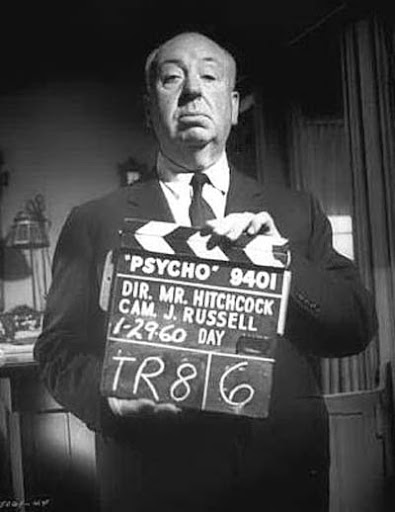
One of the most famous-- and possibly apocryphal-- Hitchcock anecdotes concerns a five-year-old Alfred Hitchcock, sent to the local police station with a note from his father after some mischief-making.After reading the note, a sergeant put young Alfred in a cell, and left him there for a few agonizing moments.The policeman returned and let Alfred go, only to tell him, "This is what we do to naughty boys." True or not, this story and Hitchcock's Roman Catholic background encompass all the themes Hitchcock would later put in his work-- terror inflicted upon the unknowing, and sometimes innocent victim; guilt (both real guilt and the appearance of it); fear, and redemption.
This is the film that best epitomises how Hitchcock could mis-direct audiences and play games with them.Psycho (1960) is the "mother" of all modern horror suspense films - it single-handedly ushered in an era of inferior screen 'slashers' with blood-letting and graphic, shocking killings (e.g., Homicidal (1961), The Texas Chainsaw Massacre (1974), Halloween (1978), Motel Hell (1980), and DePalma's Dressed to Kill (1980) - with another transvestite killer and shower scene).
It is based on the novel of the same name by Robert Bloch, which was in turn inspired by the crimes of Wisconsin murderer Ed Gein. The film depicts the encounter between a secretary, Marion Crane (Janet Leigh), who is in hiding at a motel after embezzling from her employer, and the motel's owner, the lonely Norman Bates (Anthony Perkins).
SAUL BASS (1920-1996) was not only one of the great graphic designers of the mid-20th century but the undisputed master of film title design thanks to his collaborations with Alfred Hitchcock, Otto Preminger and Martin Scorsese. He is known for reinventing the movie title as an art form.
Haunting is the word to describe the vertical bars sweeping across the screen in a manic, mirrored helter-skelter motif at the beginning of Hitchcock’s 1960 Psycho. This staccato sequence is an inspired symbol of Norman Bates’ fractured psyche. Hitchcock also allowed Bass to work on the film itself, notably on its dramatic highpoint, the famous shower –murder scene with Janet Leigh.
TRIVIA
This week, Filmclub brings to you student films from
the following schools. These were received as entries
for the Chitrakatha film festival held at NID

Aug 26th
ANAOLU UNIVERSITY, Turkey
USC SCHOOL OF CINEMATIC ARTS

Aug 28th
NANYANG POLYTECHNIC, Singapore
BEZALEL ACADEMY OF ART AND DESIGN, Jerusalem
UNIVERSIDAD POLITECNICA DE VALENCIA, Spain
 Revered Czech animator Svankmajer's 1993 film is a virtually dialogue-free exploration of the strange intimate workings of the lives of six common people. Through a disturbing mix of live action and the wondrous stop-motion animation that the director is famous for, the humdrum lives of a postwoman, shopkeeper, television presenter, detective, and two apartment dwellers are examined and intertwined while we see the elaborate processes these people go through to satisfy strange fetishes which involve food, animals, and everything in between in a way which is not all sexual to the observer.
Surrealism is a cultural movement that began in the early-1920s, and is best known for the visual artworks and writings of the group members.
Surrealist works feature the element of surprise, unexpected juxtapositions and non-sequitur; however many Surrealist artists and writers regard their work as an expression of the philosophical movement first and foremost, with the works being an artifact. Leader Andre Breton was explicit in his assertion that Surrealism was above all a revolutionary movement.
Surrealism developed out of the Dada activities of World War I the most important center of the movement was Paris. From the 1920s on, the movement spread around the globe, eventually affecting the visual arts, literature, film, and music, of many countries and languages, as well as political thought and practice, and philosophy and social theory
{ For the Surrealist Manifesto }
Woodstock was a profit-making venture, aptly titled
"Woodstock Ventures". Around 186,000 tickets were
sold beforehand and organizers anticipated approximately
200,000 festival-goers would turn up. Tickets for the event
cost US$18 in advance and $24 at the gate for all three days.
Ticket saleswere limited to record stores in the greater New
York City area, or by mail via a Post Office Box at the Radio
City Station Post Office located in Midtown Manhattan. As
the day of the festival neared, almost double the number of
expected people turned up and demanded that the concert be
made a free one.

The festival came amidst military conflict abroad and racial
discord at home. It was the biggest bash for the counterculture
and is a reminder of the youthful hedonism and excess of the 60s.
It was a culmination of what the counterculture meant—
the bands appealed to the generation that was questioning the
direction of American society. Many of the biggest artists
of the 60s performed at the Festival, and it was their influence on
the youth that brought them together to a farm in Bethel to
struggle against bad weather, food shortages and poor sanitation.
The site of Woodstock became, for four days, a countercultural
mini-nation. Minds were open, drugs were available and "love"
was "free". It was a festival where nearly 400,000 "hippies"
came together to celebrate under the slogan of "three days
of peace and music"

Woodstock- 3 days of peace and music, is a 1970 documentary
on the Woodstock Festival. The film was directed by Micha l
Wadleigh and was edited by (amongst others) Martin Scorsese
 and Thelma Schoonmaker. It received the Academy Award
for Documentary Feature, as well as a nomination for Best Sound.

TRIVIA
•  The documentary was reportedly edited from 120 miles of
 footage shot at the three-day concert.
•  While they don't appear in the film, or on the soundtrack,
a number of other artists played at Woodstock, such as The
Grateful Dead, Incredible String Band, Creedence Clearwater
Revival, Johnny Winter and Ravi Shankar played through the rain.
•  There is a small portion of footage of Jerry Garcia in the film
holding a joint, and also of him discussing the traffic problems
while tuning his guitar.
•  Though the Doors did not play at Woodstock, drummer
John Densmore can be seen briefly watching Joe Cocker from
the side of the stage.


